Why Monthly Legionella Testing Leaves Buildings Exposed

For most building owners and facility managers, Legionella risk management is built around one reassuring idea: monthly testing equals compliance.
A sample is taken, sent to a lab, results come back, and the box is checked for another 30 days.
Unfortunately, real-world data and operational experience tell a very different story. Monthly Legionella testing does not reflect how quickly conditions can change inside building water systems — and in many cases, it leaves buildings exposed for weeks without anyone knowing.
This article explains why the gap exists, what the data shows, and how building managers can reduce risk without abandoning regulatory compliance.
The assumption behind monthly testing
Monthly testing was never designed to be a real-time safety net.
It was introduced as a minimum compliance requirement, intended to:
- Detect sustained contamination
- Provide a regulatory checkpoint
- Trigger corrective action once thresholds are exceeded
What it does not assume is that:
- Legionella levels remain stable for 30 days
- System conditions stay constant between samples
- A single sample represents the whole system
In modern buildings, none of these assumptions hold true.
How fast Legionella can actually grow
Legionella is not a slow-moving contaminant.
In cooling towers and complex water systems, growth can accelerate rapidly when conditions align:
- Temperature between ~25 °C and 45 °C
• Biofilm presence
• Nutrient availability
• Reduced disinfectant residual
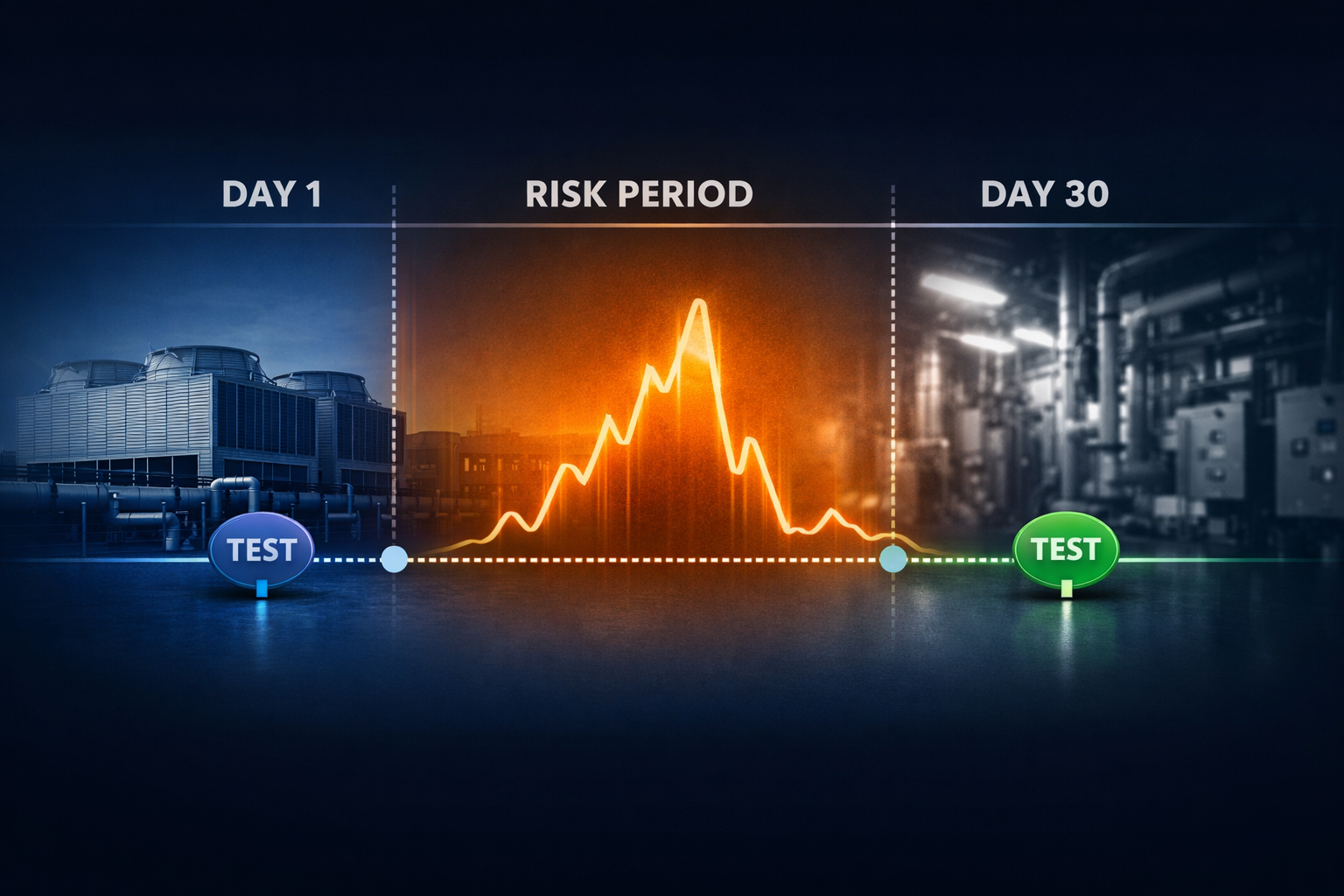
Field data from industrial, commercial, and public buildings shows that Legionella levels can move from non-detectable to intervention thresholds in a matter of WEEKS — sometimes less.
This means a system can be:
- Safe on Day 1
- At risk on Day 6
- Still “compliant on paper” until Day 30
By the time the next monthly sample is taken, the exposure has already happened.
The hidden exposure window
Monthly testing creates what risk managers call a blind exposure window.
Here’s why:
- Sampling frequency
One data point every 30 days cannot capture short-term spikes. - Analytical delay
Culture-based results typically take 7–14 days after sampling. - Decision lag
By the time a result is received, system conditions have often changed.
In practical terms, this means:
- Legionella may be present and growing for weeks
- Corrective actions are based on past conditions, not current ones
- Occupants are exposed long before alarms are triggered
Monthly testing does not fail because labs or regulations are inadequate — it fails because biology moves faster than the testing cycle.
What the data from Québec cooling towers shows
Large-scale regulatory data confirms this is not a theoretical issue.
Analysis of cooling tower testing over a five-year period shows:
- Nearly half of cooling towers experienced at least one exceedance
- One tower out of ten exceeded intervention thresholds more than ten times
- Hundreds of emergency shutdowns occurred despite compliance programs
These are not rare events or “bad actors.” They reflect normal system variability in real buildings.
The conclusion is clear: Legionella exceedances are structural, not exceptional — and monthly testing detects them late, not early.
Why single monthly samples are misleading
Even when monthly results come back “acceptable,” they can be misleading for three reasons:
1. Spatial variability
Cooling towers and building water systems are not uniform.
• Contamination may originate upstream, downstream, or in biofilm zones
• A single sampling point may completely miss the problem
2. Temporal variability
Legionella levels fluctuate with:
- Load changes
- Maintenance activities
- Weather conditions
- Restart events
Monthly snapshots cannot capture these dynamics.
3. Analytical limitations
In systems with high microbial background:
- Culture results may be delayed, invalid, or have elevated detection limits
- Action thresholds become harder to interpret
The result is a false sense of security — not because testing is wrong, but because it is too infrequent to manage a dynamic risk.
Compliance does not equal control
This is an uncomfortable but necessary distinction.
- Compliance asks: Did you follow the rule?
- Control asks: Did you reduce risk?
Monthly testing satisfies compliance requirements. It does not provide operational control.
That gap explains why:
- Facilities can be compliant and still experience outbreaks
- Shutdowns often appear “sudden” or “unexpected”
- Corrective actions are reactive instead of preventive
Modern risk management increasingly recognizes that time-to-detection matters more than test frequency on paper.
What higher-frequency monitoring changes
When Legionella is monitored more frequently — weekly, every few days, or continuously — the risk profile changes fundamentally:
- Spikes are detected early, before thresholds are crossed
- Mechanical or chemical failures are identified faster
- Corrective actions are targeted and proportional
- Exposure duration is reduced from weeks to days — or hours
This is not about replacing mandatory culture testing. It is about closing the time gap that monthly testing cannot cover.
Many standards and guidelines now explicitly recommend:
• Combining compliance testing with higher-frequency monitoring
• Using faster methods to guide operational decisions
• Treating Legionella as a process control variable, not just a lab result
A practical way forward for building managers
Building managers do not need to choose between compliance and protection.
A pragmatic approach includes:
- Maintaining mandatory culture testing for regulatory compliance
- Adding higher-frequency monitoring to manage real risk
- Using rapid results to guide day-to-day decisions
- Documenting trends, not just isolated results
This layered strategy:
- Reduces exposure windows
- Improves decision-making
- Strengthens defensibility with regulators and insurers
- Protects occupants without increasing unnecessary shutdowns
The takeaway
Monthly Legionella testing was designed as a minimum requirement, not a safety guarantee.
In modern buildings with complex water systems:
- Legionella can grow faster than the testing cycle
- Risk develops between samples, not at them
- Delayed detection equals prolonged exposure
The question is no longer: Are we compliant?
It is: How long could we be exposed without knowing?
Closing that gap is the next evolution of Legionella risk management — and it starts by recognizing the limits of monthly testing.
Proof in the field
- Validated through large-scale regulatory data and real building operations
- Peer-reviewed research confirms rapid Legionella dynamics in cooling systems
- Field experience shows exposure windows shrink dramatically with higher-frequency monitoring
Does not replace mandatory culture testing where required.